A map of ideologies
Why do people tend to cluster into well-defined ideological groups? My hypothesis is that people share “fundamental beliefs” that condition their political thought. I initially proposed a list of 9 such beliefs, which I have expanded to 14 for this analysis. However, these beliefs are often redundant; strong correlations between them suggest they are actually derived from even deeper, more fundamental priors. The goal of this analysis is to determine what those truly fundamental beliefs are.
I curated a dataset of 276 thinkers, philosophers, politicians, leaders, writers, and economists from across history. I assigned each a score from 1 to 5 in the following categories (leaving them blank where undetermined). A detailed explanation of what the axes represent can be found here.
- State power: (Anarchist – Absolutist)
- Tradition: (Iconoclast – Traditionalist)
- Order: (Emergence – Agency)
- Human Nature: (Fixed – Malleable)
- Economy: (Positive sum – Zero sum)
- Theoretical Reason: (Empirical – Rationalist)
- Instrumental Reason: (Laissez Faire – Technocratic)
- Moral Unit: (Individual – Collective)
- Justice: (Process – Outcome)
- Metaphysics: (Secular – Supernatural)
- Time: (Reactionary – Progressive)
- Strategy: (Voluntarism – Coercion)
- Universalism: (Particularist – Universalist)
- Epistemology: (Closed – Open)
The final dataset can be downloaded and explored here.
You might disagree with the scoring for many of these individuals, and that is fine! If so, I encourage you to adjust the numbers according to whichever criterion you find defensible and rerun the analysis using this notebook.
Untangling the fundamental beliefs
Because the 14 axes are redundant, we need to reduce them to the minimum number of independent variables. To do this, I performed a Factor Analysis, a multivariate technique that identifies shared variance to reveal the underlying structure explaining the data.
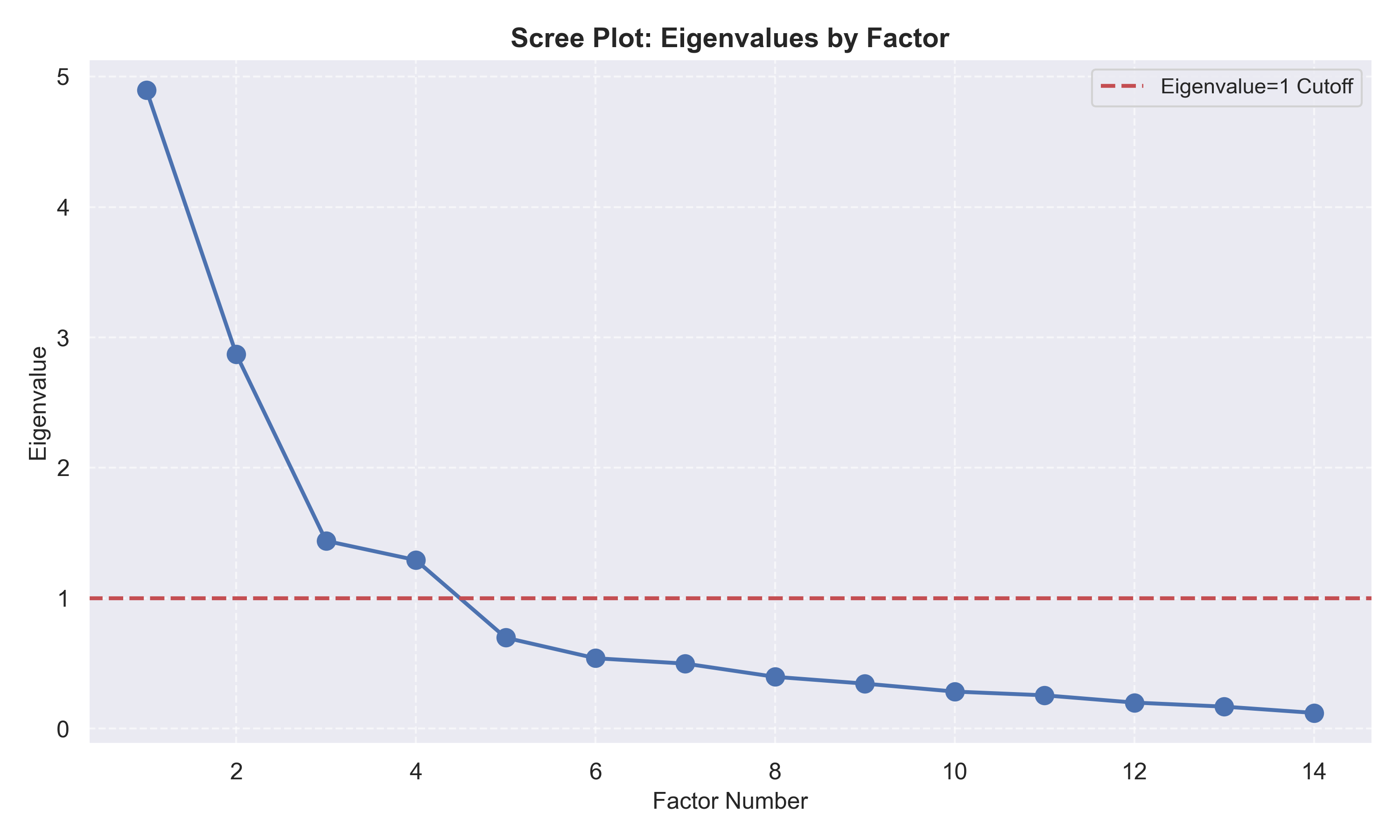
The following scree plot shows the explanatory power of these factors. Anything above the red dashed line can be considered an independent factor. As you can see, two main factors drive most of the ideological differences, with two minor ones just above the cutoff.
There is a potential flaw in this analysis, however: the factors might be heavily influenced by the specific thinkers included in the dataset. If you include only anarcho-capitalists, you will find total consensus on the “evil” role of the state; include only communists, and you will find total agreement on the meaning of economic justice.
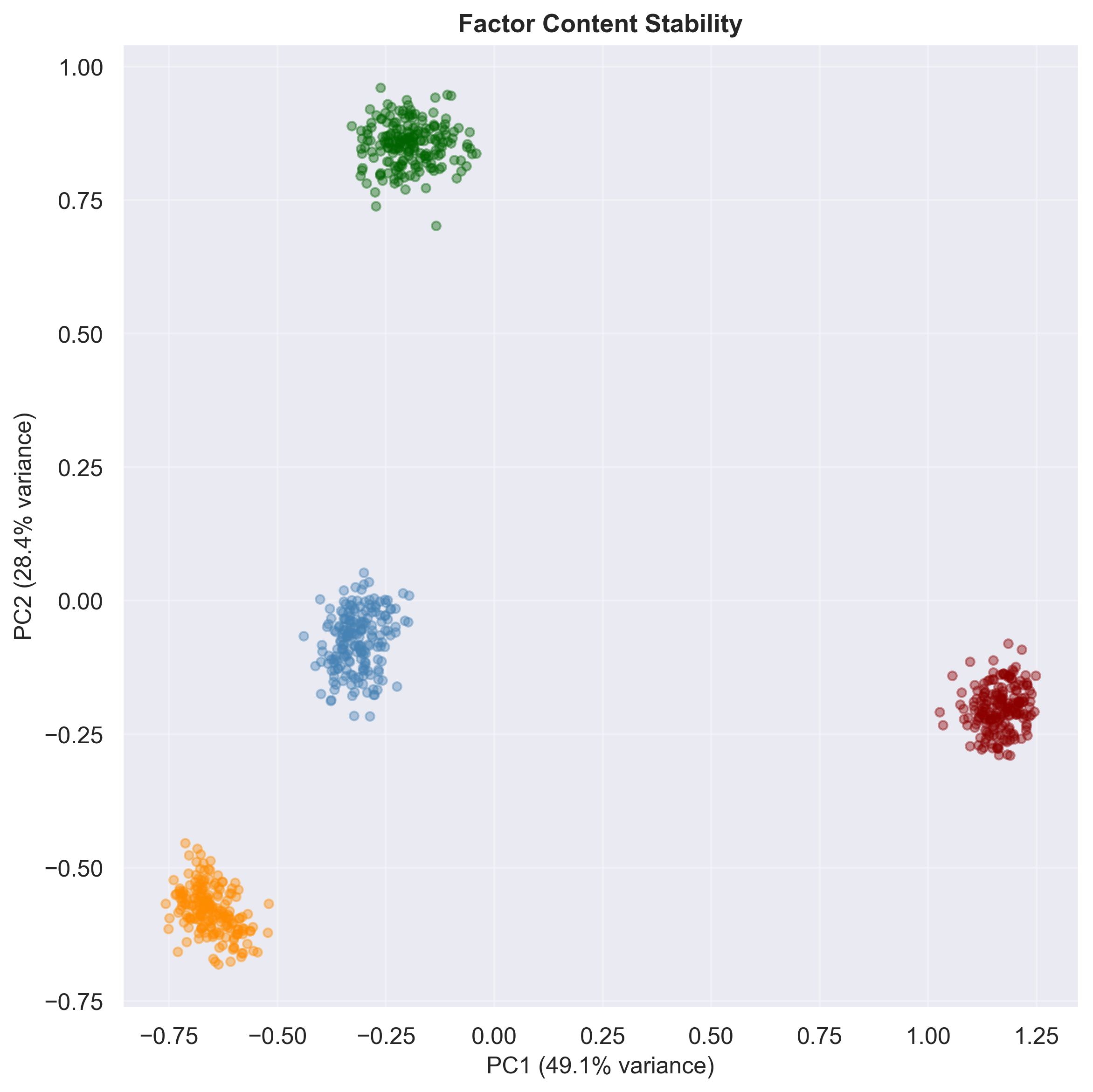
To measure the robustness of the factors, I performed a bootstrap analysis, resampling the individuals with replacement and repeating the factor analysis each time. I then took the loading of the different vectors of each factor and plotted them in a PCA. If the factors are consistently influenced by the same variables, we should expect well-defined groups. That is exactly what we see:
I did, however, observe something interesting. Although the content of the factors was very constant, the relative importance of two of them was sensitive to the thinkers included. This is clearly visible in the violin plot below:
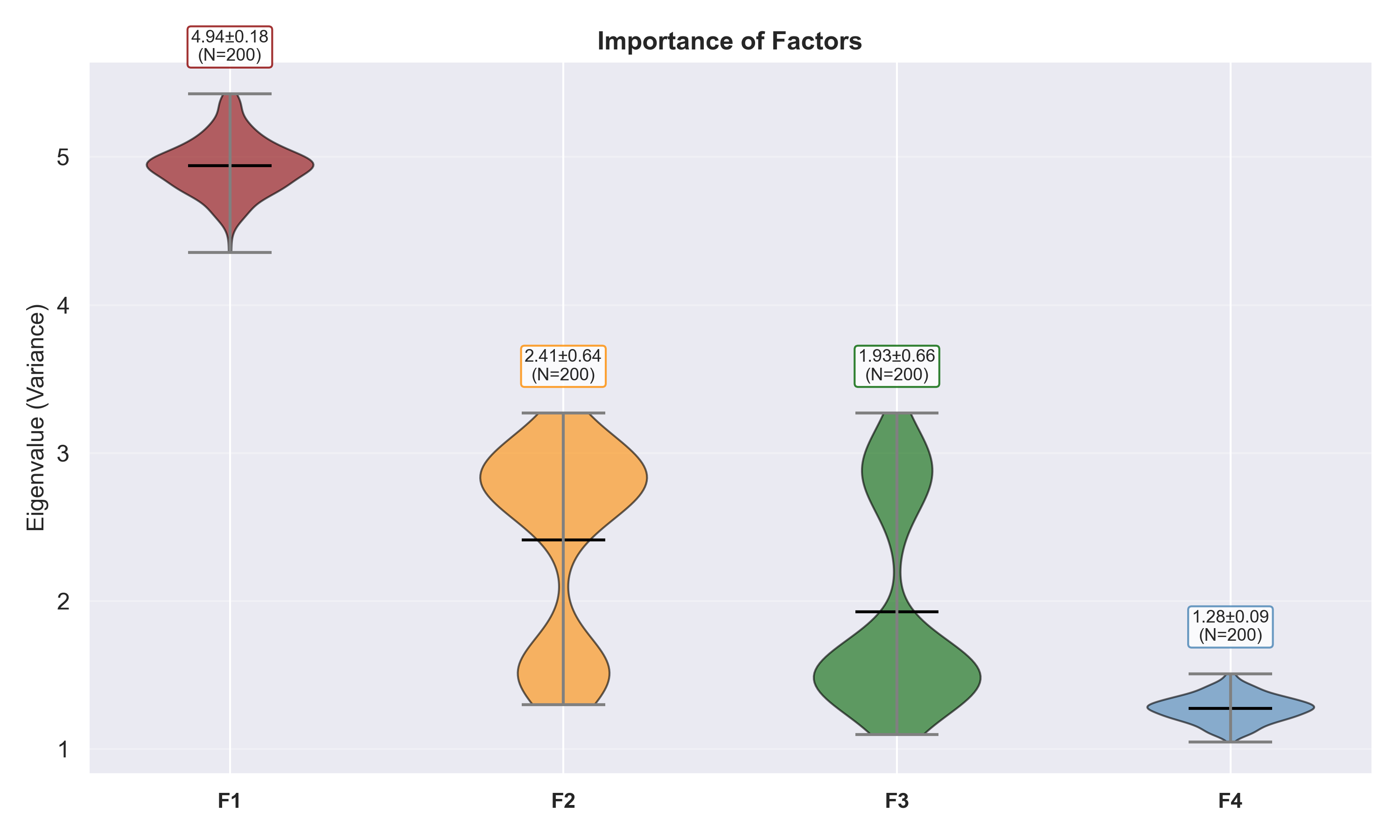
Factor 1 and Factor 4 always appear in that order of importance. Factors 2 and 3, however, seem to swap positions with some frequency. Depending on which individuals are sampled from the dataset, we sometimes see what we call F2 appear in the third position and vice versa.
In summary: all factors are very robust. One factor (F1) captures most of the variance and its dominance is robust to sampling. The other three are robust in content, but the ranking of the two intermediate ones depends slightly on the exact sampling of individuals. For simplicity, we will refer to these as the major factor and the three minor factors.
What do the factors represent?
The easiest way to interpret the factors is to correlate them with the original variables.
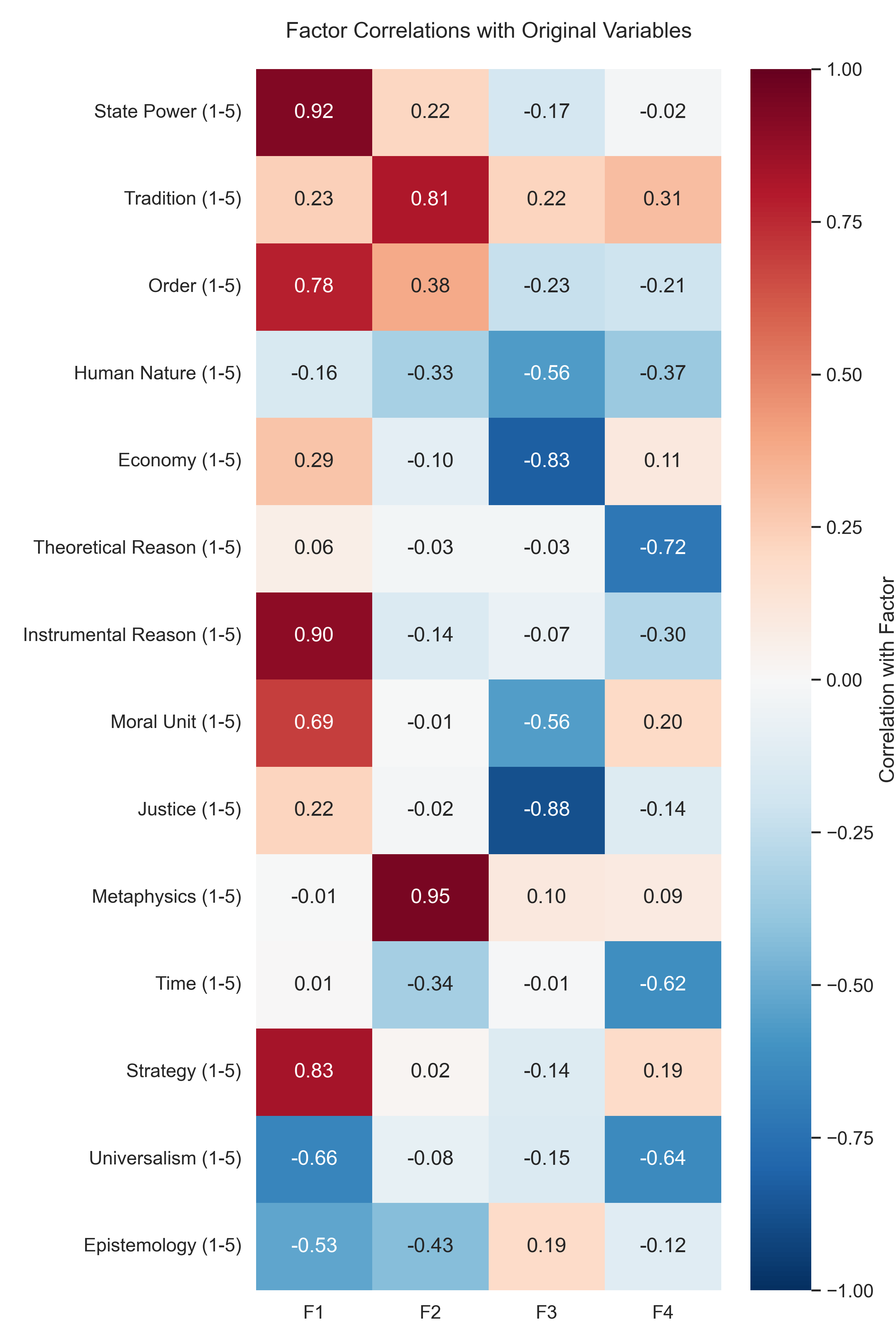
Factor 1 - The Major Factor: Bottom-up vs. Top-down This factor appears to be the single most important predictor of ideology. It has a very strong positive association with State Power, Order, Instrumental Reason, Moral Unit, and Strategy, and a negative association with Universalism and Epistemology. This factor points to two fundamental visions of a good society. On one hand, you have the top-down vision: societies must be organized by a strong agent (a military or religious leader, the state, technocrats) that knows what is best for the collective. On the other hand, you have those who believe that societal organization is an emergent phenomenon that does not require strong planners or social engineers.
Individuals with very low values of F1 tend to be figures who reject coercion, such as Gandhi, Tolstoy, or Saint Francis of Assisi. Conversely, people with very high values of F1 include leaders such as Oda Nobunaga, Otto von Bismarck, or Qin Shi Huang.
Factor 2: Secularism vs. Traditionalism This factor is defined by Tradition and Metaphysics on one end, and Open Epistemology on the other. Individuals who score low on F2 include Max Stirner, Antonio Gramsci, and Baron Haussmann, figures who opposed tradition in one way or another. On the other side of the distribution, we find religious thinkers such as Plotinus, Ramanuja, and Al-Ghazali.
Factor 3 - Socialism vs. Liberalism This factor correlates most strongly with Justice and Economy. People who view exchanges and wealth as zero-sum games tend to believe that fairness is about redistribution. They also tend to see human nature as inherently malleable, implying that a better society can be engineered through “the right education.” Conversely, those who do not consider wealth a zero-sum game tend to favor a process-based understanding of fairness. This factor is closest to what we traditionally call “left” and “right.”
Examples of individuals with low F3 values are Jean-Jacques Rousseau, David Graeber, and Karl Marx. Examples of individuals with high F3 values include Elon Musk, Margaret Thatcher, and Thomas Sowell.
Factor 4: Progressivism vs. Conservatism This factor is positively influenced by Theoretical Reason, Time, and Universalism. High scorers believe in the Enlightenment project: Reason is a tool to improve the human condition, and the best times are ahead of us. Scientists and technologists tend to cluster here (Albert Einstein, G.W. Leibniz, Elon Musk), while conservative thinkers score low (Burke, Heidegger).
Exploring the map of ideologies
In the following plots, you can see how different individuals group when plotted along these dimensions. (This may be difficult to view on a mobile phone; on a desktop, you can clearly see which thinkers appear together in the space of ideologies.) Some individuals appearing close together might surprise you given their traditional labels, but remember that these labels are often the result of motivated reasoning. Sunnis and Shiites might be ideological opponents “within” Islam, but add a secular atheist thinker to the group, and their differences appear trivial by comparison.
Can we predict positions on specific issues?
My initial observation was that people tend to hold consistent positions across many different topics. If this is true, and the factor analysis has found meaningful differences in the data, we should be able to use these factors to predict the positions of these individuals across a wide range of political and sociological questions.
To verify this, I filtered the dataset to include only modern-day thinkers and politicians for whom specific policy positions are known. I assigned them a binary score for 10 different questions:
- Climate change concern
- Pro-tariff
- Higher taxes
- Restrict immigration
- National or supranational sovereignty
- Pro-choice
- Affirmative action
- Gun rights
- Minimum wage
- Drug legalization
The filtered dataset is here.
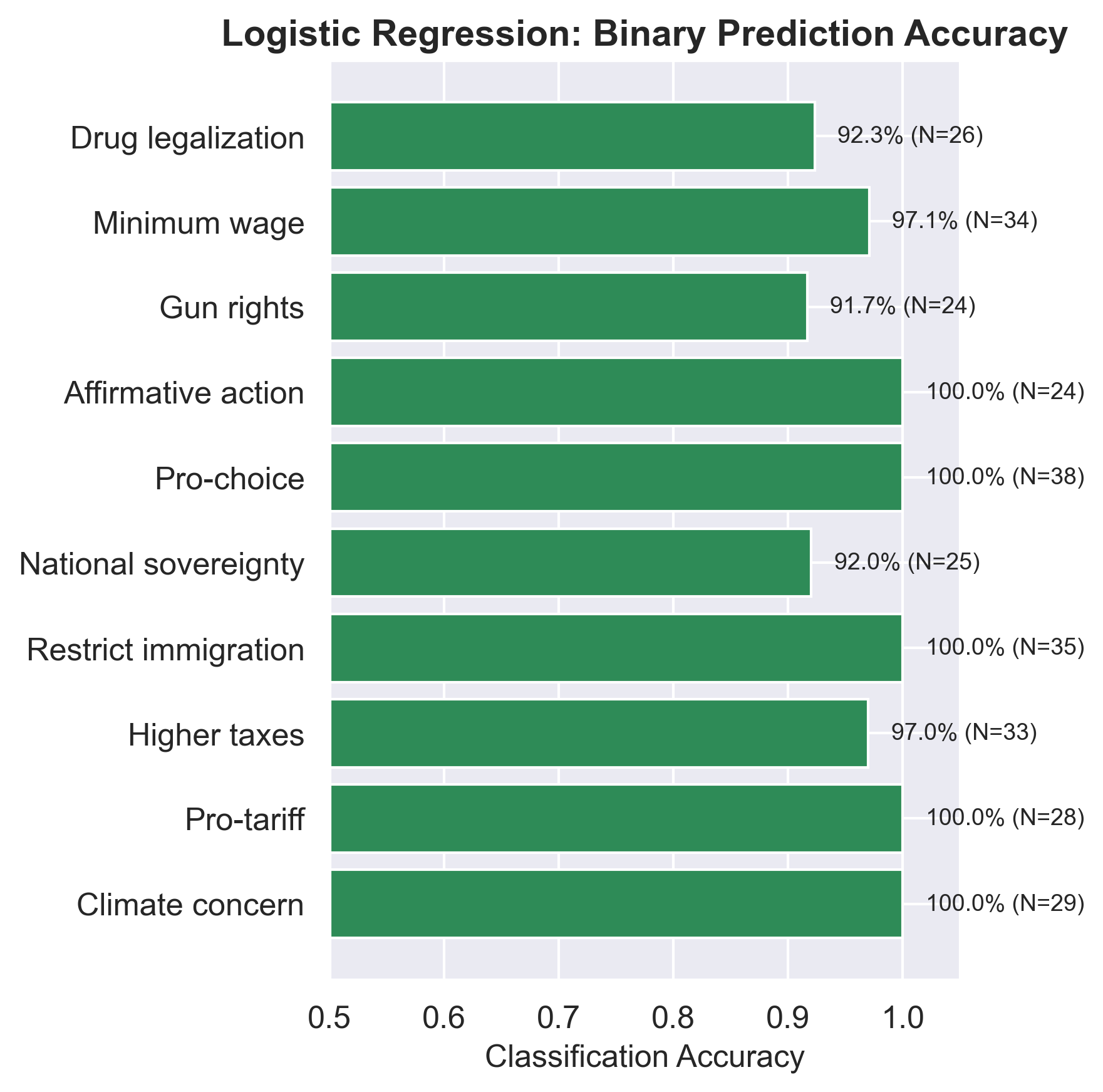
If we run regressions using the 4 factors as predictors, can we predict what these individuals would say? It turns out we can, and surprisingly well.
As shown above, most variables are predicted with a very high level of accuracy (the lowest being gun rights, which is still over 90%). If the factors weren’t capturing something fundamental about the ideology of these individuals, the prediction accuracy would be significantly lower. The data suggests these factors predict worldviews very precisely.
The remaining question is: which fundamental factors carry the most weight in the regression? We can see that in the next heatmap:
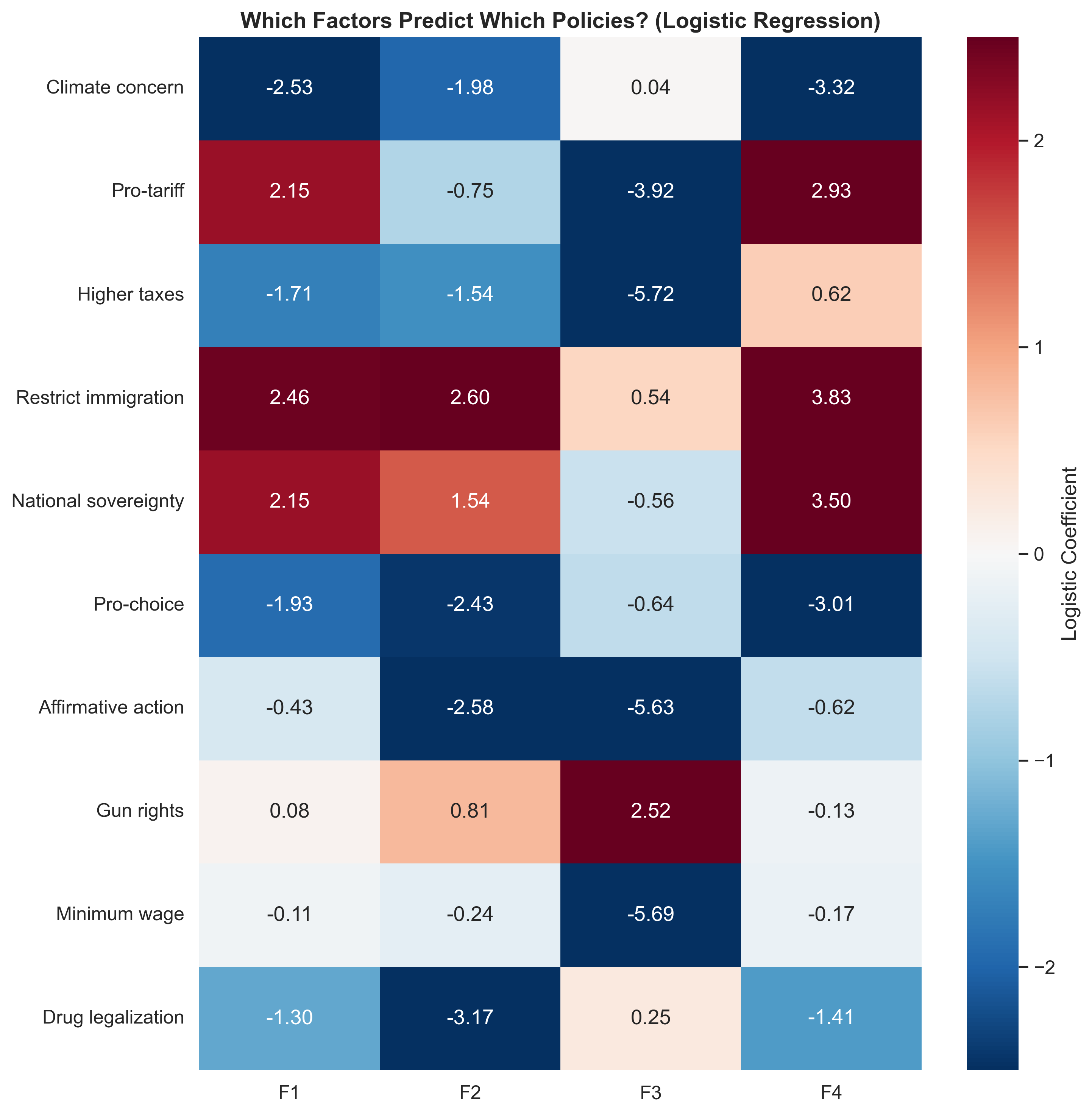
One interesting takeaway from this heatmap is that although F1 is the major factor in terms of capturing division among thinkers, there is no single policy question for which it is the strongest predictor. I suspect that F1 represents a “meta-philosophy” that runs very deep, but specific policy questions rely on input from other axes. Specifically, F2 drives social issues, F3 drives economic issues, and F4 drives cultural ones, though the lines between these categories are, of course, blurry.
I do not find it surprising that the strongest associations in the dataset appear in F3, specifically regarding Higher Taxes, Affirmative Action, and Minimum Wage. These remain some of the most divisive questions in modern political discourse.
Some thoughts
-
One major fundamental belief creates the deepest ideological divide between thinkers: the belief that societal organization must occur top-down via competent planners vs. the belief that it occurs from the bottom up. This is the essence of the Keynes vs. Hayek confrontation, Robert Moses vs. Jane Jacobs, or Mao Zedong vs. Deng Xiaoping.
-
Three other beliefs explain most of the remaining ideological stances: Religious vs. Secular, Economics/Justice, and Progressivism vs. Conservatism.
-
Thomas Sowell divided thinkers into those with the “Constrained” vision and the “Unconstrained” vision. I am not sure this distinction is entirely accurate based on this data. I previously assumed that top-down planners held an unconstrained view of human nature, but I now realize this is not the case. Top-down planning beliefs can arise from Hobbesian reasoning (humans are selfish/evil and we need a state to enforce good) or Utopian reasoning (humans are malleable and if we teach them the correct way, we will reach the perfect society).
-
Hayek’s observation in The Road to Serfdom that communism and fascism are merely two manifestations of the same ideology is roughly correct when looking at the first axis. For instance, Giovanni Gentile (the philosopher of fascism) and Maximilien Robespierre cluster together.
-
The traditional left/right axis is mostly contained within the second and third axes. This distinction fails to capture the most important fundamental factor separating ideologies (F1). I suspect this is because public discourse is mostly controlled by people who score very low on the F1 factor (rejection of absolute top-down authority), making the differences in F1 seem less salient in daily politics.
-
Two thinkers who consider themselves mortal enemies can, in fact, hold very similar structural ideas. It is better to analyze real beliefs rather than slogans. For example, while Hitler and Stalin would have mutually destroyed each other, their ideas in many aspects were identical; the fact they ended up as enemies was largely due to historical contingencies.
-
Knowing how a person scores on these 4 axes makes it possible to predict, with high accuracy, their position across a wide range of issues, from gun control and drug legalization to tariffs and abortion.
-
Running and polishing this analysis took way longer than I expected!
-
I plan to take this analysis in two new directions. First, I want to focus on current ideological divisions by collecting real-world data; I am already working on a questionnaire to distribute to friends and internet strangers in collaboration with my friend Jose Blanca. Second, I intend to take a completely different approach: using multi-agent systems to model the evolution of political ideas, simulating how these clusters emerge from simple interactions.