Painting with acrylic
Today I have been painting a whale on a small wooden canvas. It is the first time I have really painted something in a long time and my first time ever using acrylic. I found the experience relaxing and very pleasant. I will repeat it! The result is not totally bad, but I can do it better next time. The whale looks like this (the yellowish hue is due to the lighting).
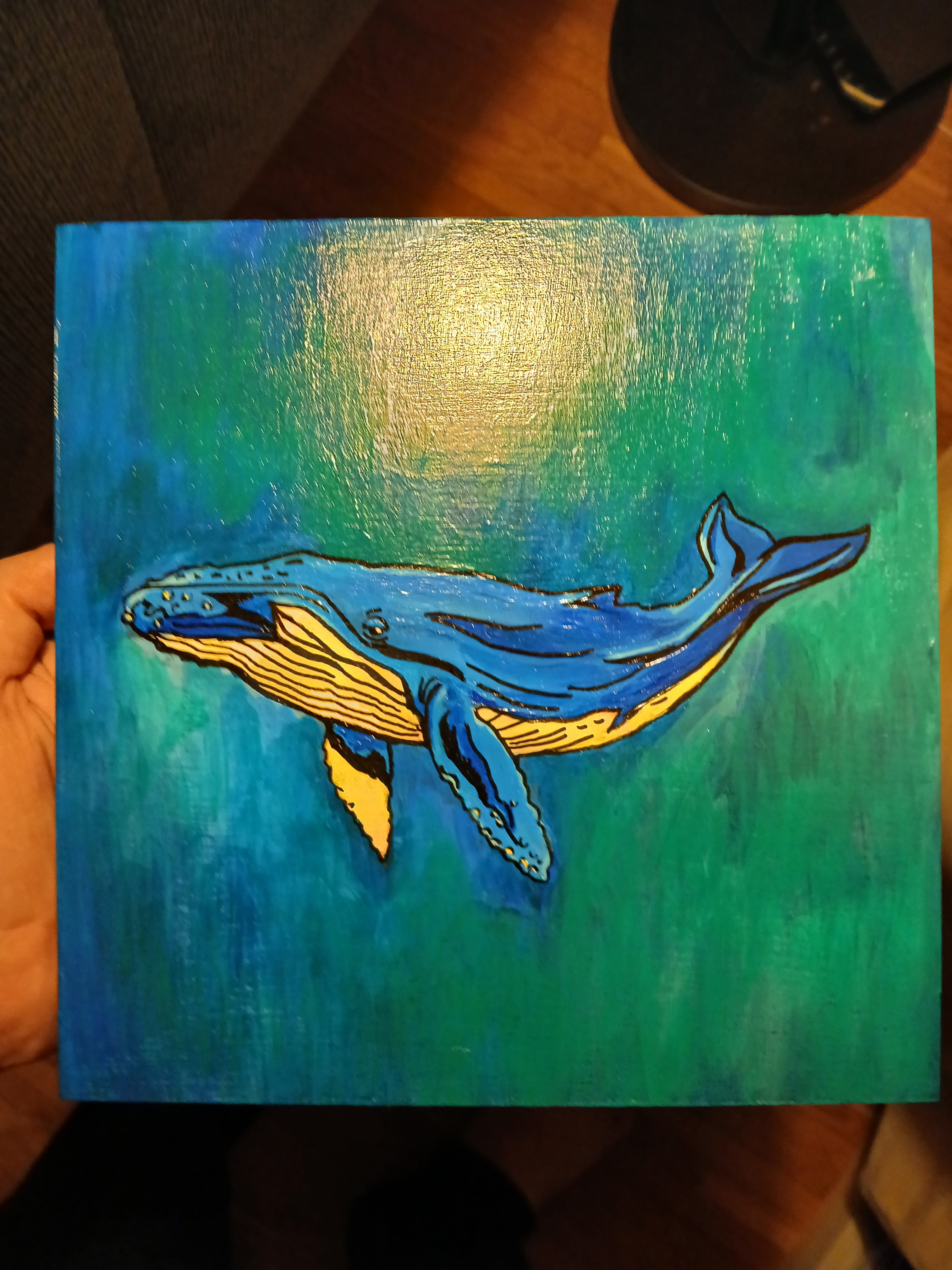
Some of the things that went wrong were:
- I printed the whale in black and white to transfer it to the canvas. Once I started transferring, I could not easily see the parts I had already transferred. Next time, print in light grey
- The transfer paper was not very effective. I might not have attached it properly
- I did the toning with an orange color that was not diluted enough.
- I did not choose the colors wisely. The blue background was too similar to the color of the whale. I must be able to see these things happening in advance
- I don’t think the background turned out especially nice because I didn’t plan it out beforehand
- I was not systematic enough with the coloring. The colors had some clear and well-defined layers, but I did not respect them. I think I need to be more intentional about the color layers
- The black acrylic marker that I bought was way too thick and difficult to control for the size of the painting. Luckily enough, I had a thinner marker that worked perfectly
- I am not sure I understood how to use glazing
In general, I think it is good to have a list of steps because there were many things to do and it was easy to miss steps:
- Prepare the drawing digitally
- Make sure you have planned both the background and the subject. Think about the colors
- Prepare the canvas by applying multiple layers of gesso and sand in between
- Print the drawing in light grey
- Make sure that both the transfer paper and the drawing are well attached
- Tone the canvas with a complementary color to the main color of the painting
- Use a pencil to add anything missing from the image
- Add matte medium
- Paint the sides
- Start painting, from back to front.
- The back must look hazy and muted. Punchy colors for the foreground
- Use layers. Use glazing to add shades
- Paint from dark to light. Use shift and lift
- Use the marker to draw the lines.
- Apply an isolation coat
- Apply varnish (2 layers, perpendicular)